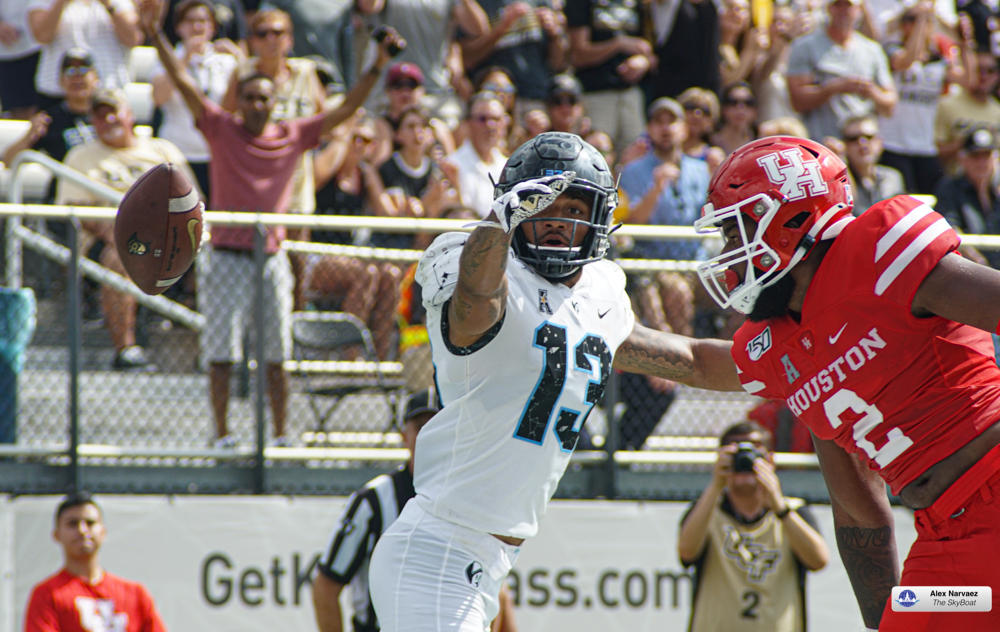

ORLANDO, Fla. – Late in the second quarter of the UCF vs. USF game senior running back Adrian Killins is aggressively pulled down to the ground.
Both teams, riled up with anger, begin to throw punches, and a fight breaks out. Players from both teams flood onto the field to join as coaches desperately try to hold them back.
As a result, both teams got two calls for unsportsmanlike conduct. Luckily, due to the same number of calls on each team, the penalties offset themselves.
The Knights haven’t had this same luck throughout the season. Penalties have proven to be an issue for the Knights throughout their 2019 season.
“Penalties are in the course of the game,” UCF head coach Josh Heupel said. “But, pre-snap and post-whistle penalties can’t happen. You can’t do that.”
This season alone, UCF has managed to accumulate 101 penalties in their 12 games, four more than the 97 that they got in their 13 games in 2018.
Out of 130 teams, UCF ranks in the 125th spot for number of penalties. The Knights average 8.5 penalties per game, while the Air Force Academy, the number one spot, average 3.5 penalties per game.
The Knights’ aggressive and fast-paced style of play will naturally assert some mid-play penalties. It’s the before the snap and after the snap penalties that the coaches have a problem with.
“Those are the ones [the coaches] get on us about,” safety Richie Grant said. “Those are things we shouldn’t have happening on this team.”
Pre and post-whistle penalties have been major contributors to UCF’s three losses.
In the Tulsa game, it was an illegal substitution on UCF’s part that resulted in Tulsa getting their game-winning first down just as UCF was about to get the ball back.
“That’s on us as coaches, and that can’t happen,” UCF assistant coach Willie Martinez said. “When you’re trying to do matchups, there are no excuses for it, and we take full responsibility for that. That’s not on the players; that’s on us.”
UCF defensive lineman Nate Evans said that the situation was frustrating, but as a leader he can’t be mad and throw a tantrum.
“I just try to pick those guys up,” Evans said. “It hurts, but I mean, it’s in the past now.”
At Cincinnati, the Knights suffered a false start call in the first quarter, which subsequently lead to UCF kicking for a field goal on a drive that had touchdown potential.
A touchdown would have caused the Knights to get either six or sevens points as opposed to the three that they received from the field goal. This three or four-point difference could have caused a tie or a win for UCF.
In UCF’s game against Pittsburgh, the Knights got called for being offsides just as the Panthers were preparing for a fourth-down play on the 5-yard line. Five plays later, the Panthers scored a touchdown that won them the game.
If the Knights had been able to stop the Panthers here, they still would have been in the lead and could have won the game.
Defensive coordinator Randy Shannon has his own view on penalties.
“Penalties come when guys play hard, they play physical,” Shannon said.” Metal penalties are the ones where they jump offsides, and they learn from that, so we gotta move forward.”
The Knights’ next and final game will be their bowl game. They will head west on I-4 for the Gasparilla Bowl against Marshall, whom they have plenty of history with. Being that all of their losses this season have not been at home, the Knights must make sure they keep the penalties down to a minimum.
“Penalties had been something early in the year, the midpoint in the season, something that was an issue… we have continued to get better at them,” Heupel said.
Written by Giulia Sliva